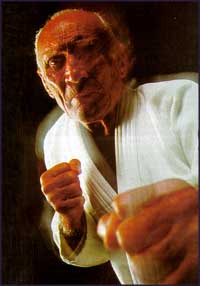
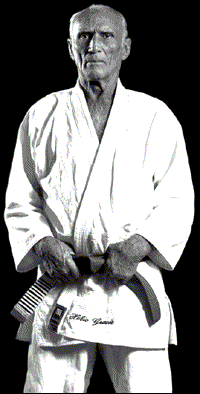

H�lio Gracie (born October 1, 1913) is
the co-founder of "Gracie Jiu-Jitsu," also known as
Brazilian
Jiu-Jitsu (BJJ). He is a master of the discipline and is widely
considered as one of the first sports heroes in Brazilian history; he
was named Black Belt Magazine's Man of the Year in 1997.
When H�lio Gracie was 16 years old, he
found the opportunity to teach a Jiu-Jitsu class, and this experience
led him to develop Brazilian Jiu-Jitsu. The Director of the Bank of
Brazil, Dr. Mario arrived for class as scheduled. The instructor Carlos
was running late and was not present. H�lio offered to begin the class
with the man. When the tardy Carlos arrived offering his apologies, the
student assured him it was no problem, and actually requested that he be
allowed to continue learning with H�lio instead. Carlos agreed to this
and H�lio began as an instructor. H�lio realized however, even though he
knew the techniques theoretically, in actuality, the moves were much
harder to execute. Due to his smaller size, he realized many of the
jiu-jitsu moves required brute strength that his physical nature did not
allow. He began adapting the moves for his particular physical
attributes, and through trial and error learned to maximize leverage,
thus minimizing the force that needed to be exerted to execute the move.
From these experiments, Gracie Jiu-Jitsu, formally Brazilian Jiu-Jitsu,
was created. Using these new techniques, smaller and weaker opponents
gained the capability to defend themselves and even defeat much larger
opponents.
H�lio was involved in an attack on Luta-Livre
teacher Manoel Rufino dos Santos in 1937, at the age of 24. In a
Interview for Playboy Magazine he regretted that act with this
statement:
|
� |
It was 66 years ago. that I was
involved in my biggest trouble. A famous fighter in Brazil [a
former luta livre champion] Manoel Rufini dos Santos. said that
he was going to show the world that we Gracies were nothing. It
was at the Tijuca Tenis Clube of Rio that I gave my answer to
him. I arrived and said "I came to answer the declaration that
you made". He throw a punch and I took him to the ground, with
two fractures of his head, and a broken clavicle, and blood
spurting out. But it was a foolish act that I did. Today I would
never repeat such a thing. |
� |
H�lio was arrested and sentenced to two
and a half years in jail. An appeal was made to the Supreme Court by
H�lio's lawyer Romero Neto and the sentence was upheld, as the court
said "Today it was with Manoel Rufini dos Santos. Tomorrow it will be
us." A couple of hours after that decision Brazilian President Get�lio
Vargas pardoned H�lio. According to H�lio, one of his students had a
brother who was an ambassador and was very close to Get�lio, and he
intervened in favor of H�lio. H�lio and Get�lio subsequently met many
times and H�lio eventually taught Get�lio's son Maneco.
H�lio stated in an interview that he had
around 15 fights. He began his fight career when he submitted
professional boxer Antonio Portugal in 30 seconds in 1932. Also in 1932
he fought American professional wrestler Fred Ebert for fourteen 10
minute rounds until the event was stopped by the police. In 1934 H�lio
fought professional wrestler Wladak Zbyszko, who was being billed as a
"world champion", for three 10 minute rounds. That match was declared a
draw. H�lio did win against Taro Miyake, a Japanese professional
wrestler who worked for Ed "Strangler" Lewis in the U.S.
H�lio also fought in Brazilian Jiu-Jitsu
vs. Judo matches. In 1932 he fought Japanese judoka Namiki. The fight
ended in a draw, but according to the Gracies the bell rang just seconds
before Namiki would have tapped out. H�lio had two fights with Japanese
judoka Yasuichi Ono after Ono choked out H�lio's brother George Gracie
in a match. Both fights ended in a draw. H�lio fought another Japanese
judoka Kato twice. The first time was at Maracan� stadium and they went
to a draw. Afterwards, H�lio asked for a rematch. The rematch was held
at Ibirapuera Stadium in S�o Paulo and H�lio won by front choke from the
guard. In 1955, H�lio went on to fight leading judoka Masahiko Kimura at
Maracan� stadium with Kimura winning via bent arm lock. In 1994, H�lio
admitted in an interview that he had in fact been choked unconscious
earlier in the match, but had revived and continued fighting. In 1967,
during a live television interview, Helio was challenged by capoeira
practitioner Valdomiro. Helio, as always, accepted the challenge and
defeated him via back choke on a live television program called "Desafio
67" that took place one week after the challenge was made.
H�lio shares the world record for the longest fight in history with his
former student Valdemar Santana, a feat achieved when they spent 3 hours
40 minutes fighting with H�lio losing by technical knockout due to
exhaustion. That fight was held at the YMCA in Rio de Janeiro in May,
1955.
Father of
Rorion Gracie,
Relson Gracie, Rickson Gracie, Rolker Gracie, Royler Gracie, Robin Gracie,
Royce Gracie
-
Official Site
Grandmaster Helio Gracie's official Gracie Academy website.